

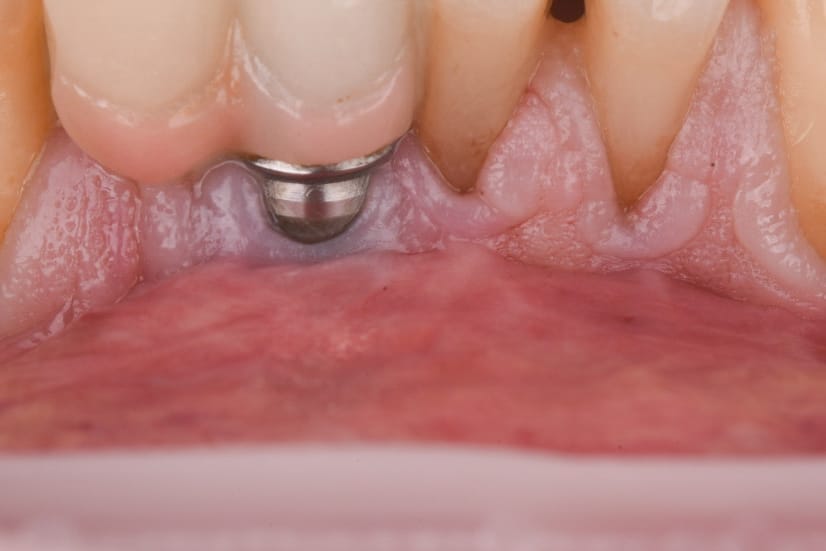
It's Not the Millimeters. It's the Plaque Control.
Few peri-implant questions get argued more than this one: how much keratinized mucosa (KM) does an implant actually need? For years the answer was a confident "two millimeters." Then a wave of studies pushed back and the number started to look arbitrary. The pendulum has settled somewhere more useful — and more practical. Here's where the evidence lands, and how to turn it into a decision you can make chairside.
The short answer: aim for at least 2 mm of keratinized mucosa on the facial of your implants. But it works indirectly — by making plaque control possible and comfortable. The most consistent effect of a narrow (< 2 mm) band is more plaque and more soft-tissue inflammation, the on-ramp to peri-implant disease.
The evidence is genuinely nuanced. The most rigorous look — a 2022 meta-analysis with trial sequential analysis — confirmed only one outcome as robust: sites with a narrow band carry significantly more plaque. A small bone-loss edge for wider KM didn't survive the conservative analysis, and the case for <2 mm as an independent "risk factor" is low-quality. Yet the authors are clear that keratinized mucosa is not inessential.
Plaque is the driver. Keratinized mucosa makes it manageable.
What the Longitudinal Data Show
In a 4-year study of 202 implants, sites with less than 2 mm of KM were 3.5× more likely to lose 1 mm or more of marginal bone — with more plaque and more bleeding along the way.
The same group's fresh 10-year follow-up is the strongest signal yet: implants with a wide (≥ 2 mm) band had 84% lower odds of developing peri-implant disease. Narrow sites accumulated more plaque, bled more, receded more, and lost more bone over the decade.
Why 2 mm Helps
A firm, bound-down collar of keratinized tissue resists the pull of cheek and muscle, gives a more stable mucosal seal, and — most importantly — lets the patient brush the site without pain.
Narrow, mobile mucosa does the opposite: it's tender, so it doesn't get brushed, so plaque builds and the tissue bleeds. More than half of narrow-KM patients report discomfort while brushing. The tissue doesn't cause disease — poor plaque control does — but the missing band is what makes good control hard.
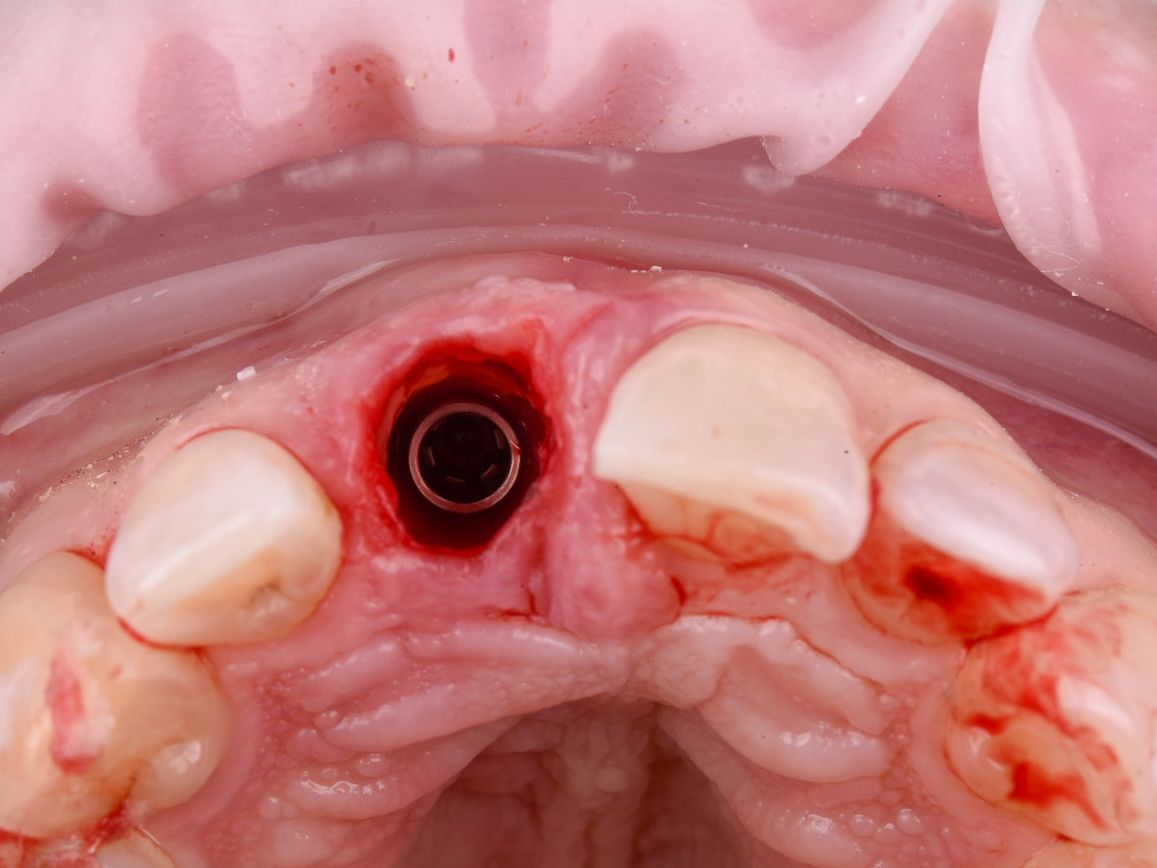
Who needs it most? The posterior mandible — where muscle pull and a shallow vestibule make a narrow band far more consequential — and any patient with only fair plaque control, because KM matters most exactly where hygiene is hardest.
Flag any implant already bleeding, receding, or that a patient calls "sore to brush." In the esthetic zone, think thickness too: 2 mm of mucosal thickness helps prevent a grey show-through at the margin.
START MONDAY
Small changes, real payoff. Four things to fold into your workflow this week:
- Chart facial KM at placement, at uncovery, and at every recall — flag anything under 2 mm.
- Add one maintenance question — "Does anything feel tender or sore when you brush right here?" A yes is a grafting cue.
- To gain width, reach for an apically positioned flap plus a free gingival graft (FGG) — the most effective option, and the only one that beats a flap alone. For thickness or esthetics, use a connective tissue graft (CTG).
- Graft before you're managing mucositis — at or before uncovery, or before you restore, not after the band is already gone.
The honest version: 2 mm is a useful target, not a bright line. The hard-tissue effects are small and inconsistent; the plaque-and-inflammation link is what's robust. An immaculate patient with 1 mm may do fine for a decade — a plaque-prone one with 1 mm in the lower molar region is the one to graft.
MORE FROM MISCH IMPLANT IQ
All issues: Misch Implant IQ archive
UPCOMING MISCH INSTITUTE COURSES
Fresh dates are posted as they're announced — see the full institute calendar at misch.com.
Full calendar and registration at misch.com.
Sources
Ravidà A, et al. The role of keratinized mucosa width as a risk factor for peri-implant disease: a systematic review, meta-analysis, and trial sequential analysis. Clin Implant Dent Relat Res. 2022;24(3):287–300. · PubMed · DOI
da Costa Deller FA, Perussolo J, de Souza AB, et al. The role of the keratinized mucosa in peri-implant diseases onset and brushing discomfort: a 10-year follow-up. Clin Oral Implants Res. 2026 (online). · PubMed · DOI
Perussolo J, Souza AB, Matarazzo F, Oliveira RP, Araújo MG. Influence of the keratinized mucosa on the stability of peri-implant tissues and brushing discomfort: a 4-year follow-up study. Clin Oral Implants Res. 2018;29(12):1177–1185. · PubMed · DOI
Monje A, González-Martín O, Ávila-Ortiz G. Impact of peri-implant soft tissue characteristics on health and esthetics. J Esthet Restor Dent. 2023;35(1):183–196. · PubMed · DOI
Tavelli L, Barootchi S, Avila-Ortiz G, Urban IA, Giannobile WV, Wang HL. Peri-implant soft tissue phenotype modification and its impact on peri-implant health: a systematic review and network meta-analysis. J Periodontol. 2021;92(1):21–44. · PubMed · DOI
Gharpure AS, Latimer JM, Aljofi FE, Kahng JH, Daubert DM. Role of thin gingival phenotype and inadequate keratinized mucosa width (<2 mm) as risk indicators for peri-implantitis and peri-implant mucositis. J Periodontol. 2021. · PubMed · DOI
Perussolo J, Matarazzo F, Dias DR, Oliveira RP, Araújo MG. The effect of brushing discomfort on peri-implant health in sites exhibiting inadequate keratinized mucosa width: a cross-sectional study. Clin Oral Implants Res. 2022;33(12):1212-1223. · PubMed · DOI
Misch Implant IQ · Educational content — not a substitute for individual clinical judgment.